
Foundation cracks are one of the most common things that worry Wichita homeowners, and also one of the most misunderstood. Some are purely cosmetic and will never cause a problem; others are an early warning that the foundation is moving and needs attention before it gets worse. The trick is knowing the difference. This guide walks through the main types of foundation cracks, what each one usually means, and when a crack is telling you it is time to call a professional.
Are All Foundation Cracks Serious?
No, and that is worth saying up front, because not every crack is a crisis. Concrete shrinks and cures as it ages, and almost every foundation develops some minor cracking over its life. A thin, stable hairline crack is often harmless. What matters is the type of crack, its direction, its width, and whether it is changing over time. A crack that is growing, letting in water, or running in a direction that signals movement is a very different story from one that has sat unchanged for twenty years.
Types of Foundation Cracks and What They Mean
The shape and direction of a crack tell you a lot about what is causing it. These are the patterns we see most often in Wichita homes.
Hairline and shrinkage cracks are thin, often vertical or spidery, and usually appear within the first year or two as concrete cures. On their own they are typically cosmetic and not a structural concern, though they can still let in water and are worth sealing.
Vertical cracks run straight up and down or lean slightly. They are common and frequently the result of minor settling. Many are not serious, but a vertical crack that is widening, especially one wider at the top or bottom, can indicate uneven settlement worth checking.
Diagonal cracks run at roughly a 30-to-75-degree angle and usually point to differential settlement, where one part of the foundation has dropped more than another. Wichita’s expansive clay, which lifts and drops unevenly across a lot, is a frequent cause. These deserve a professional look.
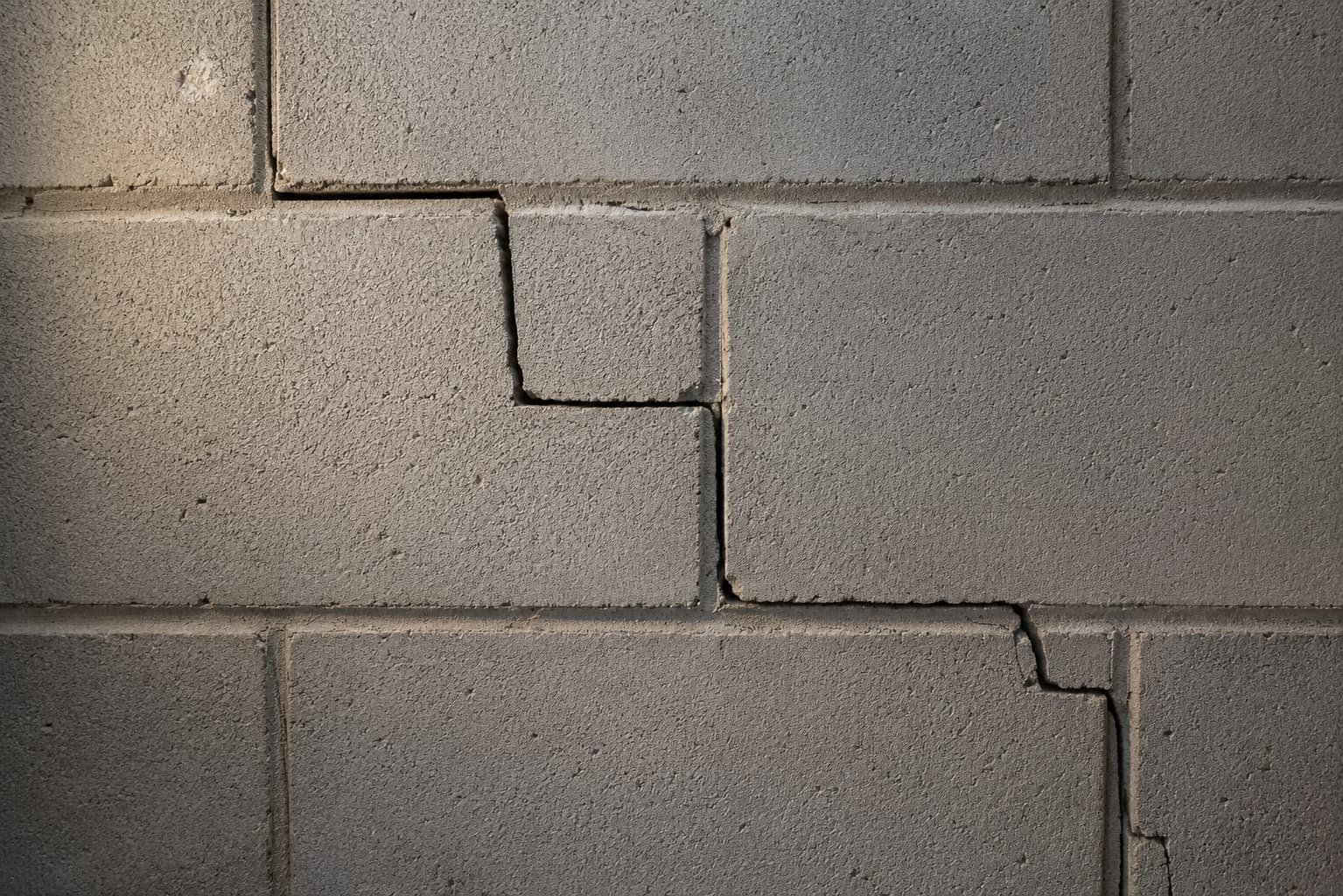
Stair-step cracks follow the mortar joints of a concrete block wall in a stepped pattern. They are a classic sign of foundation movement and soil pressure, and when they widen they often accompany a wall that is starting to lean.
Horizontal cracks are the most serious. A crack running straight across a block or poured wall, often around the middle, is the signature of soil and water pressure pushing the wall inward. Left alone, this leads to a bowing wall and eventually structural failure. A horizontal crack should always be assessed promptly, and it usually calls for bowing wall repair to brace and stabilize the wall.
Floor and slab cracks appear in basement floors and slab foundations. Narrow ones are often shrinkage, but wide cracks, or cracks with one side higher than the other, can point to a settling slab that needs slab foundation repair.
Why Wichita Homes Get Foundation Cracks
Almost every foundation crack in the Wichita area traces back to the same source: expansive clay soil. Our clay swells when it soaks up water during spring storms and shrinks as it dries through hot summers. That repeated swelling and shrinking pushes and pulls on the foundation from below and from the sides, and concrete, which is strong under compression but weak under tension, cracks where the stress concentrates.
Drainage makes it better or worse. Downspouts that dump next to the foundation, grading that slopes toward the house, and poor gutters all keep the soil saturated and the pressure high. Homes near creeks and the Arkansas River, where the water table is higher, tend to see more pressure-driven cracking. The age and type of construction matter too, with older unreinforced block walls cracking more readily than modern reinforced foundations.
The age of the home shapes the pattern as well. In newer Wichita-area subdivisions, cracks often show up in the first few years as freshly graded clay settles under a new slab, and these are usually thin and stable once the ground finds its level. In older homes, cracks reflect decades of accumulated movement, and an old crack that suddenly starts growing again is a sign the soil conditions around the home have changed and deserves a closer look.
Warning Signs a Crack Needs Attention
A crack is telling you something is wrong when you also notice the other signs of foundation movement around your home. Watch for cracks that are getting visibly wider over weeks or months, cracks wider than about a quarter inch, and any crack letting water into the basement.
Beyond the crack itself, look for doors and windows that have started to stick or no longer latch, floors that slope or feel uneven, gaps opening between walls and ceilings or floors and baseboards, and a wall that appears to be leaning or bulging. When a crack appears alongside any of these, it is no longer just a crack; it is a symptom of movement.
When to Call a Professional
If you have a horizontal crack, a widening crack, a stair-step crack with a leaning wall, or a crack paired with sticking doors and sloping floors, it is time for a professional inspection. The same is true if water is coming through a crack, since that combines a structural concern with a moisture problem.
A monitored, stable hairline crack can often simply be watched and sealed. But the cost of an inspection is nothing, and the cost of guessing wrong on a structural crack can be severe. For independent, non-commercial background on how foundations move and crack on expansive soils, the Foundation Performance Association publishes peer-reviewed guidance that matches what we see across Wichita.
How Foundation Cracks Are Repaired
The right repair depends entirely on the cause. A crack that is cosmetic or simply letting in water can be sealed with epoxy or polyurethane injection, which is the low-cost fix our foundation repair team uses when the wall itself is sound. When the crack comes with a bowing wall, the wall needs reinforcement with carbon fiber or steel before the crack is sealed. When a settling foundation is the cause, steel piers lift and stabilize the structure first. And when water pressure is driving the cracking, pairing the repair with basement waterproofing relieves the pressure so the problem does not return.
Why You Should Not Just Patch the Crack
It is tempting to fill a crack with caulk or hydraulic cement and call it done, but patching the surface does nothing about the cause. If soil movement or water pressure created the crack, that force is still there, and the patch will simply crack again or the wall will keep moving. Sealing a crack is the right finishing step once the underlying cause is addressed, not a substitute for diagnosing it.
This is why a proper inspection matters. Identifying why a crack formed, and treating that cause, is what makes a repair last rather than turning into an annual ritual of re-patching the same line.
Get Your Foundation Cracks Inspected
If you have spotted cracks in your foundation, walls, or floors and you are not sure how serious they are, the safest move is a professional inspection. Wichita Foundation Pros offers free, no-pressure inspections with a clear written diagnosis, so you know whether a crack is cosmetic or a sign of something that needs fixing. Request a free estimate or call us and we will tell you exactly what your cracks mean.